WHITE PAPER 1 | AUGUST 2026
The Cost of Not Innovating
Understanding and Managing Organisational Innovation Debt
Organisations can appear operationally successful while steadily eroding their capacity to innovate. This research-grounded white paper introduces Organisational Innovation Debt and provides a practical framework for recognising, assessing, and repaying the accumulated liabilities created when organisations defer, fragment, or underinvest in their capacity to innovate.
By Kent Matla
Version 1.0 | 64 pages | First published 28 August 2026
DOI: 10.5281/zenodo.22136891
THE CENTRAL PROPOSITION
An organisation does not avoid the cost of innovation by postponing the systems and capabilities required to realise it.
The cost does not disappear. It accumulates.
THE CONSTRUCT
What is Organisational Innovation Debt?
Innovation is commonly evaluated through visible activity and outcomes—ideas generated, pilots completed, technologies adopted, efficiencies achieved, and value realised. These measures provide an incomplete account of organisational preparedness. They do not necessarily reveal what happens when an organisation repeatedly postpones the strategic, structural, and capability investments required to innovate systematically.
A temporary capability gap is not necessarily debt. The gap becomes debt-like when it persists and produces dependence on workarounds, repeated implementation failure, duplication, knowledge loss, rising remediation costs, or reduced strategic optionality.
PRIMARY DEFINITION
Organisational innovation debt is the strategic, structural, and capability liability that accumulates when an organisation repeatedly defers, fragments, or underinvests in the systems required to realise future value through innovation.
IMPORTANT CLARIFICATION
Debt is used as a temporal management metaphor. It is not an accounting classification, a balance-sheet liability, or necessarily a monetary amount.
SIX CENTRAL PROPOSITIONS
What the paper argues
The paper advances six propositions for consideration by governing bodies, executives, researchers, and innovation practitioners.
Visible innovation activity is not the same as sustained organisational innovation capability.
A persistent gap between required and actual capability can accumulate strategic, structural, and capability liabilities.
Innovation maturity and organisational innovation debt are related but distinct.
Innovation debt can compound across the organisation’s nine interconnected innovation-management dimensions.
Repayment should be prioritised according to materiality, strategic consequence, and leverage rather than maturity scores alone.
Governing bodies and executives should oversee both the risks of undertaking innovation and the liabilities created by failing to maintain the organisation’s capacity to innovate.
THE FRAMEWORK
Where innovation debt accumulates
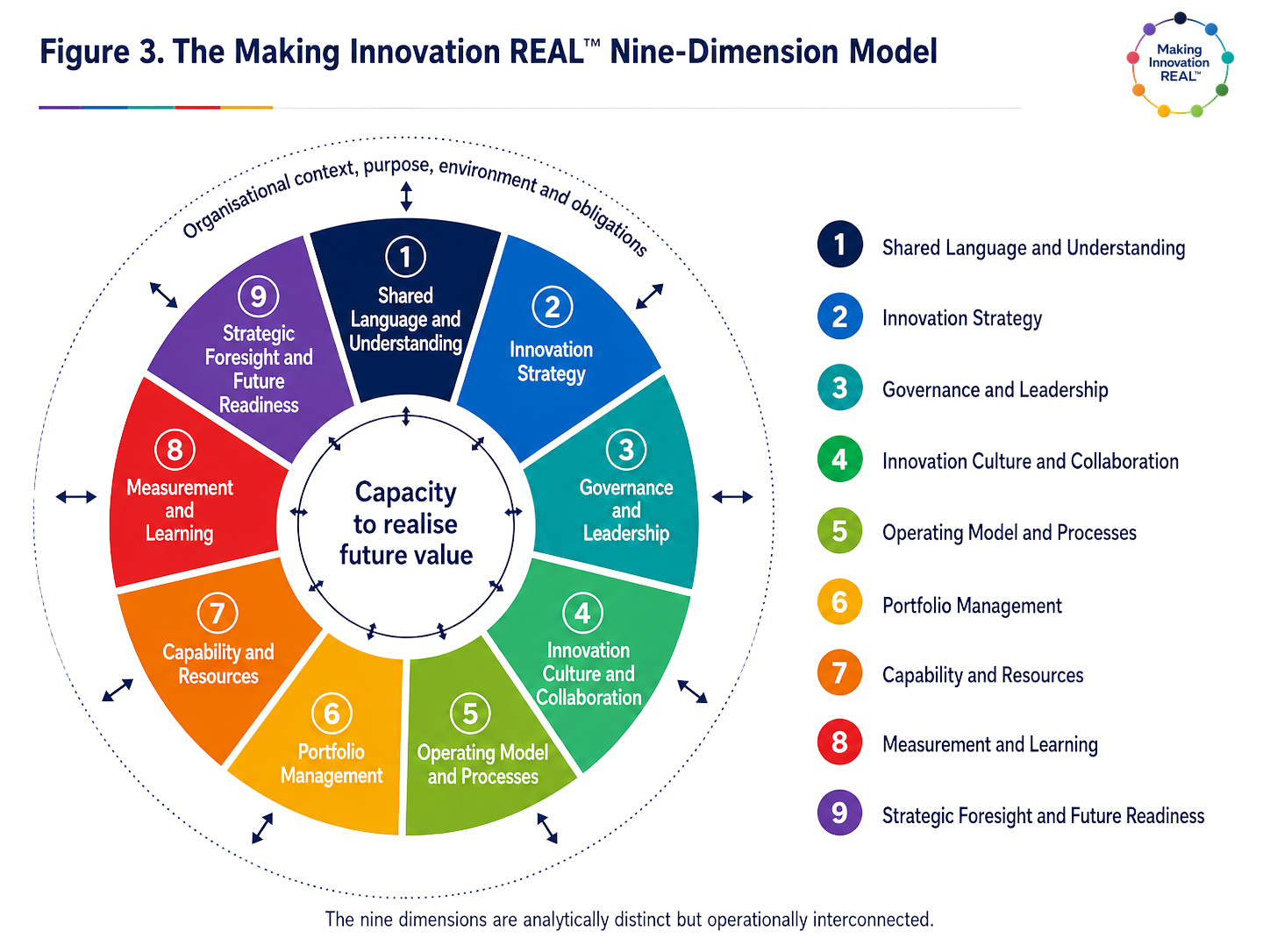
Organisational innovation debt does not accumulate in one location. It develops across the interconnected systems through which an organisation understands, directs, governs, undertakes, resources, evaluates, and renews innovation.
The Making Innovation REAL™ Nine-Dimension Model identifies nine interconnected dimensions through which innovation debt may accumulate. The dimensions are analytically distinct but operationally interconnected.
FROM DIAGNOSIS TO ACTION
A pathway for repaying innovation debt
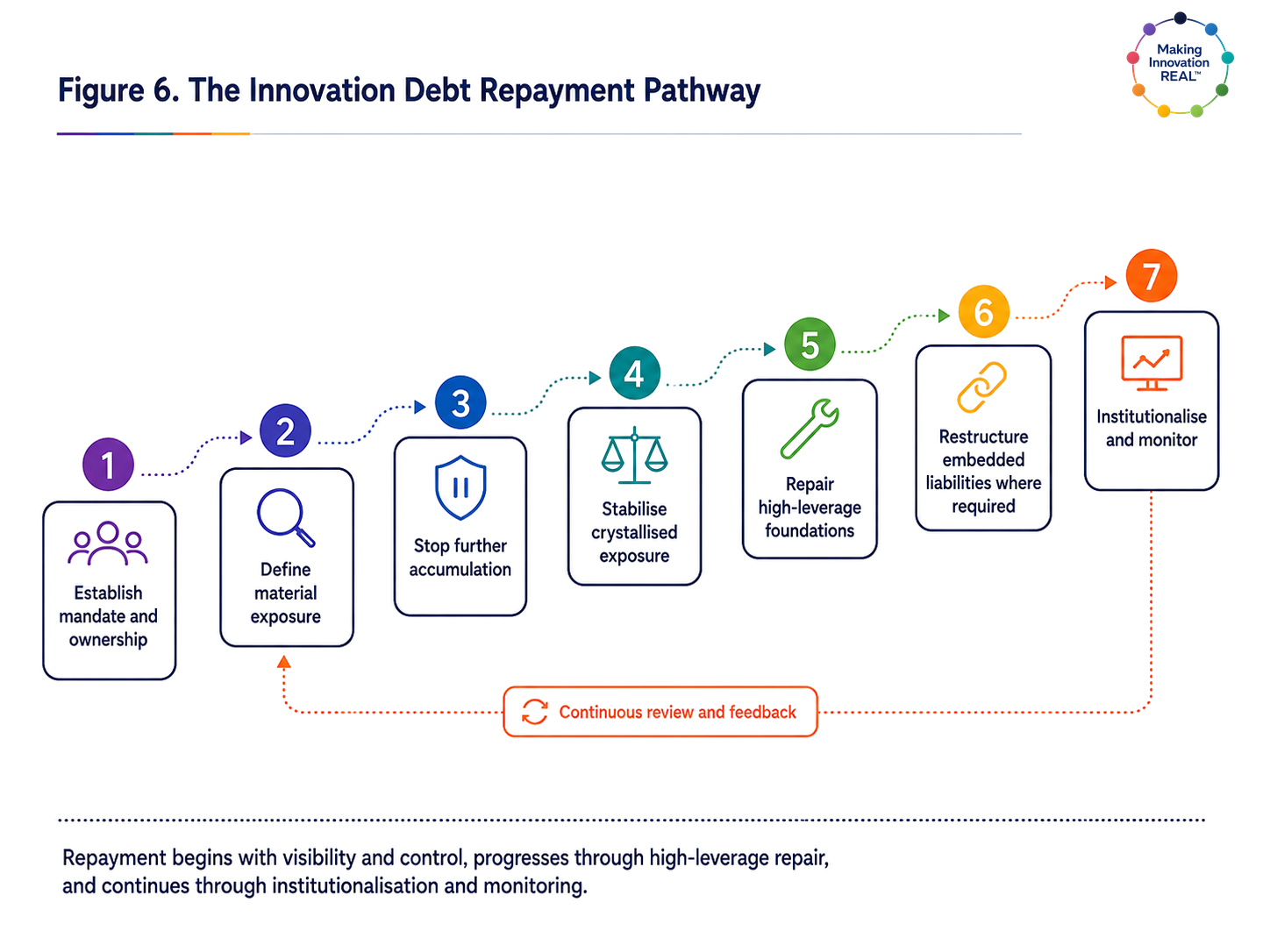
Repayment does not mean eliminating every capability gap or simply creating more visible innovation activity. It means establishing mandate and ownership, defining material exposure, stopping further accumulation, stabilising crystallised exposure, repairing high-leverage foundations, restructuring embedded liabilities where required, and institutionalising capability through continuous review and monitoring.
WHO THIS PAPER IS FOR
For leaders responsible for future value
This white paper is intended for:
• Boards and governing bodies
• Chief executives and senior leaders
• Public-sector accountable authorities and elected members
• Innovation, strategy, transformation, and policy leaders
• Researchers and innovation-management practitioners
RESEARCH STATUS
A proposed, research-grounded construct
Organisational innovation debt is presented as a proposed, research-grounded management construct. It draws on established bodies of theory, but its measurement, empirical validation, and relationships with organisational performance require further development.
Its applied development will continue through practitioner review, organisational pilots, multi-source evidence, and longitudinal case studies.
DOWNLOAD WHITE PAPER 1
Read the full paper
Download the complete 64-page white paper exploring the construct, its theoretical positioning, the Nine-Dimension Model, assessment logic, repayment pathway, governance implications, public-sector application, and future research agenda.
No registration is required.
PUBLICATION DETAILS
White Paper 1
Version 1.0
First published: 28 August 2026
64 pages
DOI: 10.5281/zenodo.22136891
White paper licence: CC BY-NC-ND 4.0
SUGGESTED CITATION
Matla, K. (2026). The Cost of Not Innovating: Understanding and Managing Organisational Innovation Debt. Making Innovation REAL™ White Paper Series, White Paper 1. https://doi.org/10.5281/zenodo.22136891
RESEARCH AND PRACTITIONER ENGAGEMENT
Organisations, researchers, and practitioners interested in contributing to the construct’s development or participating in future pilot activity are invited to contact the author.