WHITE PAPER 2 | OCTOBER 2026
When Innovation Crosses Boundaries
Building Organisational Capability for Collaborative Innovation
Collaborative innovation is an organisational capability: the capacity to identify where working across boundaries can create and capture value, form and govern relationships, combine knowledge and resources, deliver jointly, and learn from the results.
By Kent Matla
Version 1.0 | 52 pages | First published 22 October 2026
DOI: 10.5281/zenodo.23444223
CENTRAL PROPOSITION
Collaboration is a capability, not a partner count.
The presence of partners does not itself create collaborative capability.
THE CAPABILITY
What does it mean to collaborate deliberately?
Many organisations approach collaboration as a series of partnerships, research agreements, procurement arrangements, or networking events. This paper takes a more demanding view: organisations need the ability to identify where working across boundaries can create value, form and govern relationships, combine knowledge and resources, deliver jointly, and learn from the results.
Collaboration should be selective. It is useful where complementary knowledge, assets, access, or legitimacy improve the innovation outcome enough to justify the coordination and exposure. Quality and strategic fit matter more than partner numbers.
WORKING DEFINITION
Collaborative innovation is an organisational capability to identify, establish, govern, resource, and learn from purposeful innovation relationships with external actors, so that complementary knowledge, assets, and capabilities can be combined to create and realise value.
It includes the internal arrangements that make external work possible: strategic selection, boundary-spanning roles, knowledge integration, decision rights, risk management, and implementation pathways.
SCOPE
This paper focuses on each organisation’s capability to collaborate effectively with external partners, including within wider innovation ecosystems. It does not offer a method for managing or diagnosing those ecosystems.
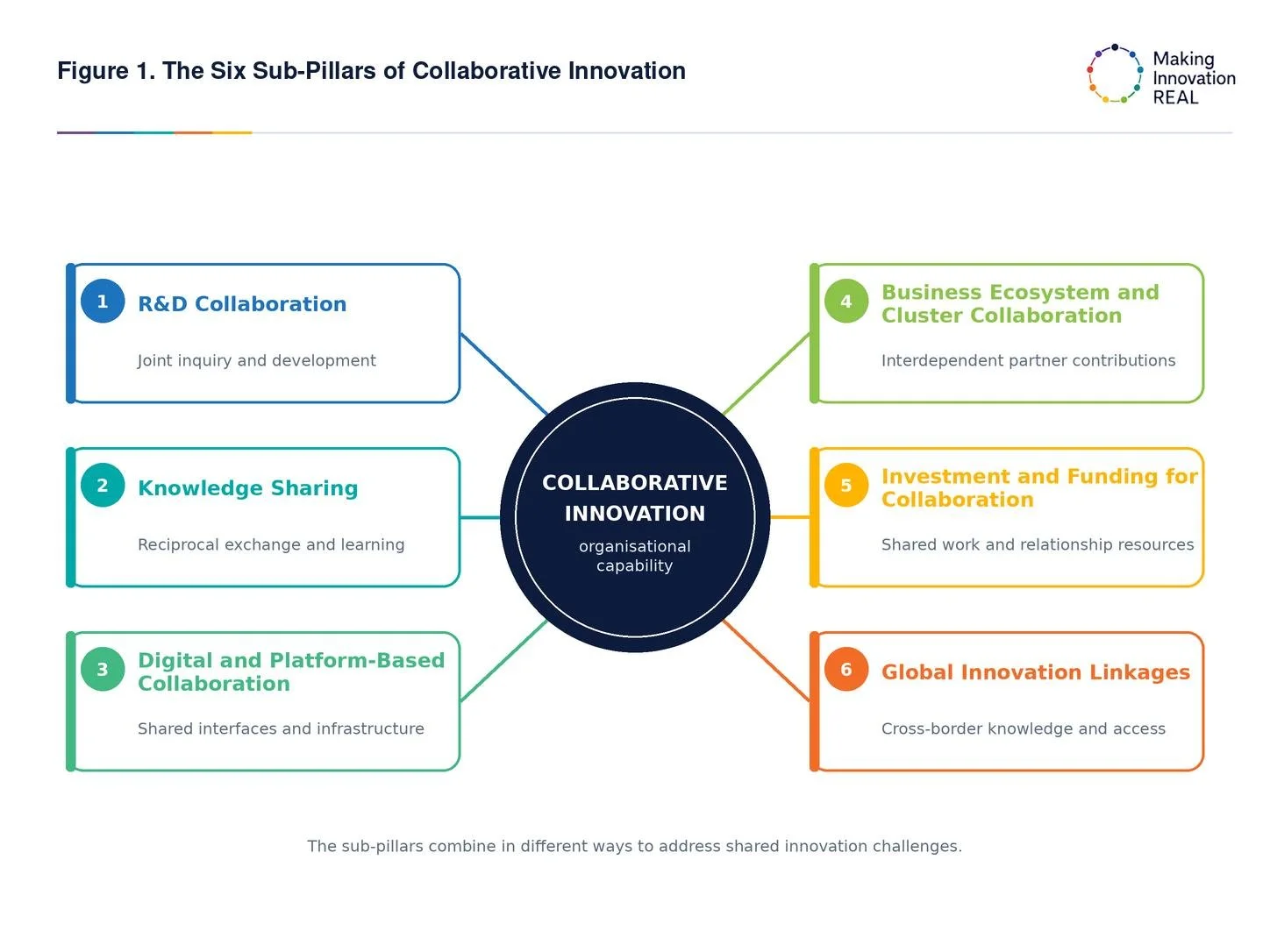
THE SIX SUB-PILLARS
A practical architecture
The six sub-pillars help leaders examine collaboration choices, governance, resources, and learning. They are connected, but they do not form a checklist that every collaboration must satisfy in the same way.
R&D Collaboration — joint research, experimentation, technology development, engineering, testing, and applied problem-solving.
Knowledge Sharing — reciprocal exchange and co-learning that helps partners interpret, recombine, and apply knowledge.
Digital and Platform-Based Collaboration — the infrastructure, interfaces, data access, and rules that enable distributed contribution.
Business Ecosystem and Cluster Collaboration — alignment with interdependent actors whose contributions shape innovation opportunities and value creation.
Investment and Funding for Collaboration — financing shared work and the relationship capability needed across its lifecycle.
Global Innovation Linkages — cross-border knowledge, market, production, and institutional connections.
The right combination depends on the problem, partners, technology, institutions, and time horizon.
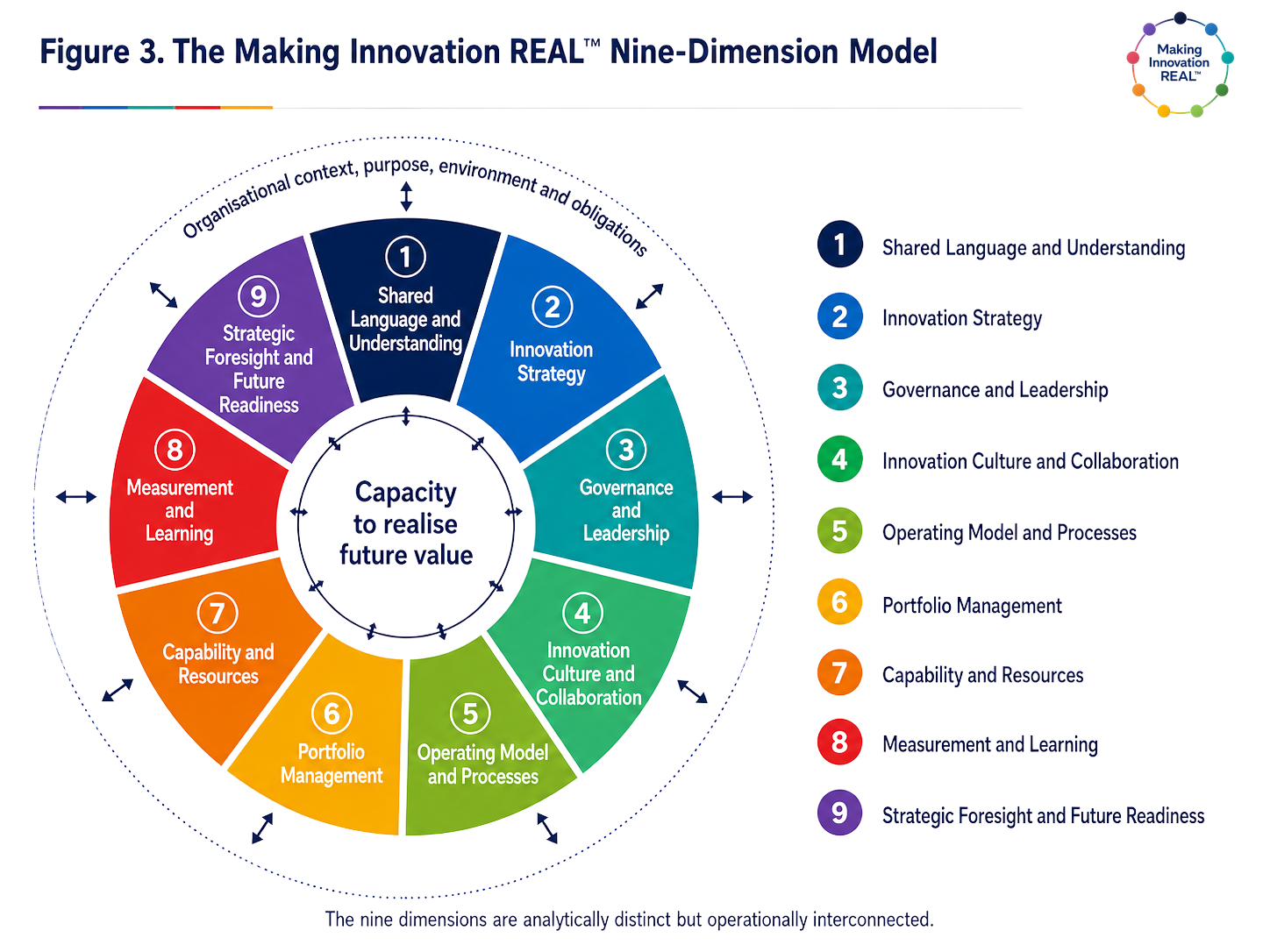
WITHIN THE MAKING INNOVATION REAL™ MODEL
A focused capability with system-wide dependencies
Collaborative innovation is most directly visible in Dimension Four (D4), Innovation Culture and Collaboration, but it depends on all nine dimensions. Strategy determines why the organisation collaborates. Governance determines who can decide. Processes and resources make joint work possible. Portfolio choices protect focus, while measurement and foresight help organisations learn and adapt.
Collaboration therefore reveals whether the innovation system can work beyond its own boundaries.
FROM OPPORTUNITY TO LEARNING
Manage the relationship across its lifecycle
Effective collaboration moves from purpose framing and partner selection through agreement, joint work, review, and renewal or exit. Governance should match the uncertainty and interdependence involved. Leaders need clear decision rights, reciprocal contributions, suitable safeguards, and resources for the relationship as well as the project.
Timing matters. Organisations need to consider when collaboration should begin, how work should be sequenced, when joint value becomes observable, and when to renew or conclude the relationship. Experience alone does not guarantee learning; deliberate reflection helps identify what to repeat, stop, or change.
WHO THIS PAPER IS FOR
For leaders responsible for innovation and performance
This paper is intended for board directors, chief executives, and executive teams responsible for strategy, innovation, risk, investment, and performance. It is relevant across business, government, universities, research organisations, intermediaries, investment bodies, and not-for-profit organisations.
RESEARCH STATUS
An analytical architecture for leadership discussion
The six sub-pillars draw on Kent Matla’s DBA research on Holistic Innovation and are applied here as an analytical lens, not as a validated scale, scored diagnostic, or universal benchmark. The paper supports structured inquiry, organisational learning, and experimentation. Further testing and refinement are needed across different organisational contexts.
DOWNLOAD WHITE PAPER 2
Read the full paper
Download the complete 52-page board and executive guide to selecting, governing, resourcing, and learning from innovation collaboration. The paper includes a collaboration lifecycle, a proportionate governance architecture, practical leadership questions, and illustrative applications. No registration is required.
PUBLICATION DETAILS
White Paper 2
Version 1.0
First published: 22 October 2026
52 pages
DOI: 10.5281/zenodo.23444223
White paper licence: CC BY-NC-ND 4.0
SUGGESTED CITATION
Matla, K. (2026). When Innovation Crosses Boundaries: Building Organisational Capability for Collaborative Innovation (Making Innovation REAL™ White Paper Series, White Paper 2, Version 1.0). Making Innovation REAL™. https://doi.org/10.5281/zenodo.23444223.
AUTHOR
Organisations and practitioners interested in discussing collaborative innovation capability are invited to contact the author.